

The beginnings of National Socialist tyranny were gradual, as was the case everywhere in Germany, and were accompanied by hope and euphoria among the wider masses. Opponents of the regime were persecuted and imprisoned early on, e.g. in the Sonnenburg (Słońsk) penitentiary and concentration camp, one of the first of its kind.
The advance of the Red Army and its allies from the east towards Berlin brought the war to the Order-Warthe region in January 1945 at the latest. On 31 January 1945, the Red Army reached the Sonnenburg (Słońsk) concentration camp. Further north, in Kienitz, a Soviet unit established the first bridgehead on the western side of the Oder at around the same time. The strategically important town of Küstrin (Kostrzyn nad Odrą) with its railway and road bridge was once again turned into a fortress and almost completely destroyed in 52 days of fighting. During the final major offensive towards Berlin that followed, tens of thousands of people lost their lives on the edge of the Oderbruch in the Battle of the Seelow Heights (16-19 April 1945); villages such as Klessin no longer exist. Shortly afterwards, the Allied troops reached Berlin and Nazi Germany surrendered in Berlin-Karlshorst on 8 May 1945.
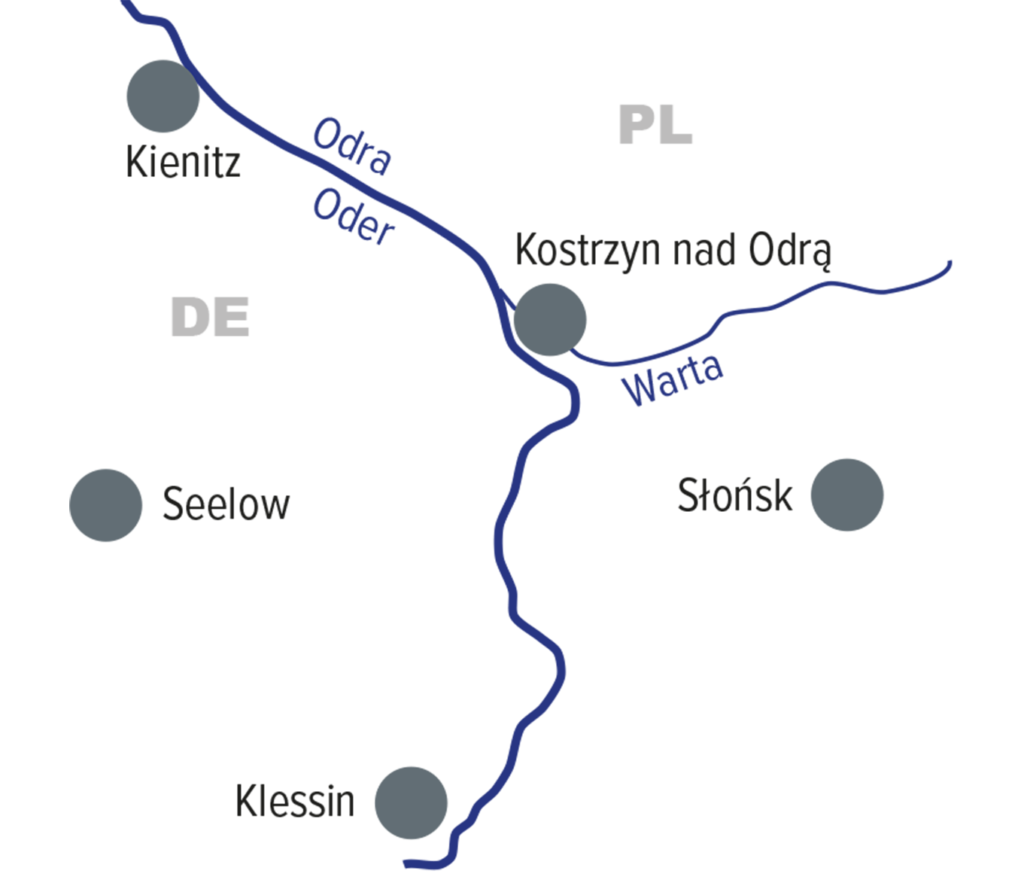
The Oder-Warthe 1945 cross-border history trail recalls the events of that time and offers fascinating insights from different perspectives. With audio files, signs and publications in at least 3 languages, it provides information on the events of 1945 at the following locations in the Oder-Warthe region:
- Martyrdom Museum Słońsk, PL
- Kienitz bridgehead memorial and armour memorial, DE
- Küstrin Fortress Museum, Kostrzyn nad Odra, PL
- Theatre of war Klessin Castle 1945, Podelzig, DE
- Seelow Heights Memorial and Museum, DE
- Museum Geschichtsstation Seelow (Mark), DE
The development and establishment of the "History Trail War Events 1945" was funded as part of the project "Remembering Together - 80 Years of the End of the Second World War 2025" within the framework of the Small Projects Fund (KPF) 2021-2027 of the PRO EUROPA VIADRINA Euroregion as part of the INTERREG VI A Brandenburg-Poland 2021-2027 cooperation programme.

It is also part of the Liberation Route Europe (European Cultural Route of Liberation 1944-1945). The Liberation Route Europe is a certified cultural route of the Council of Europe and a project of the LRE Foundation. It connects people, places and events to commemorate the liberation of Europe from occupation during the Second World War and to reflect on the long-lasting consequences and history of the war through a multinational and multi-perspective approach. With hundreds of places and stories in ten European countries, the route connects the most important regions along the Allied advance in the years 1943-1945