
Networking of German-police memorial sites for the victims of National Socialist tyranny, especially Nazi murders of the sick; development of educational and memorial tourism programmes
Interreg VI A funding project 2026-2028
The project is concerned with the reappraisal, visualisation and networking of the „History of the Nazi murders of the sick“ in Międzyrzecz, Berlin and Ueckermünde and the „Traces of Jewish life“ in Seelow, Międzyrzecz, Berlin and Ueckermünde.
In cross-border cooperation, the project partners are revitalising or re-establishing nationally significant places of remembrance, equipping them with digital exhibitions and linking them thematically with each other. In addition to sustainable investments in the expansion of the places of remembrance, the development of cross-border educational tourism offers is a project focus, with inclusive elements and the involvement of relevant target groups.
The aim is to improve access to the places of remembrance involved and thus to the shared history of the German-Polish border region, which is unique in the context of the end of the Second World War and the westward shift of Poland.
Key project outputs
„History of the Nazi murders of the sick“
- Cross-border measures for knowledge exchange and networking,
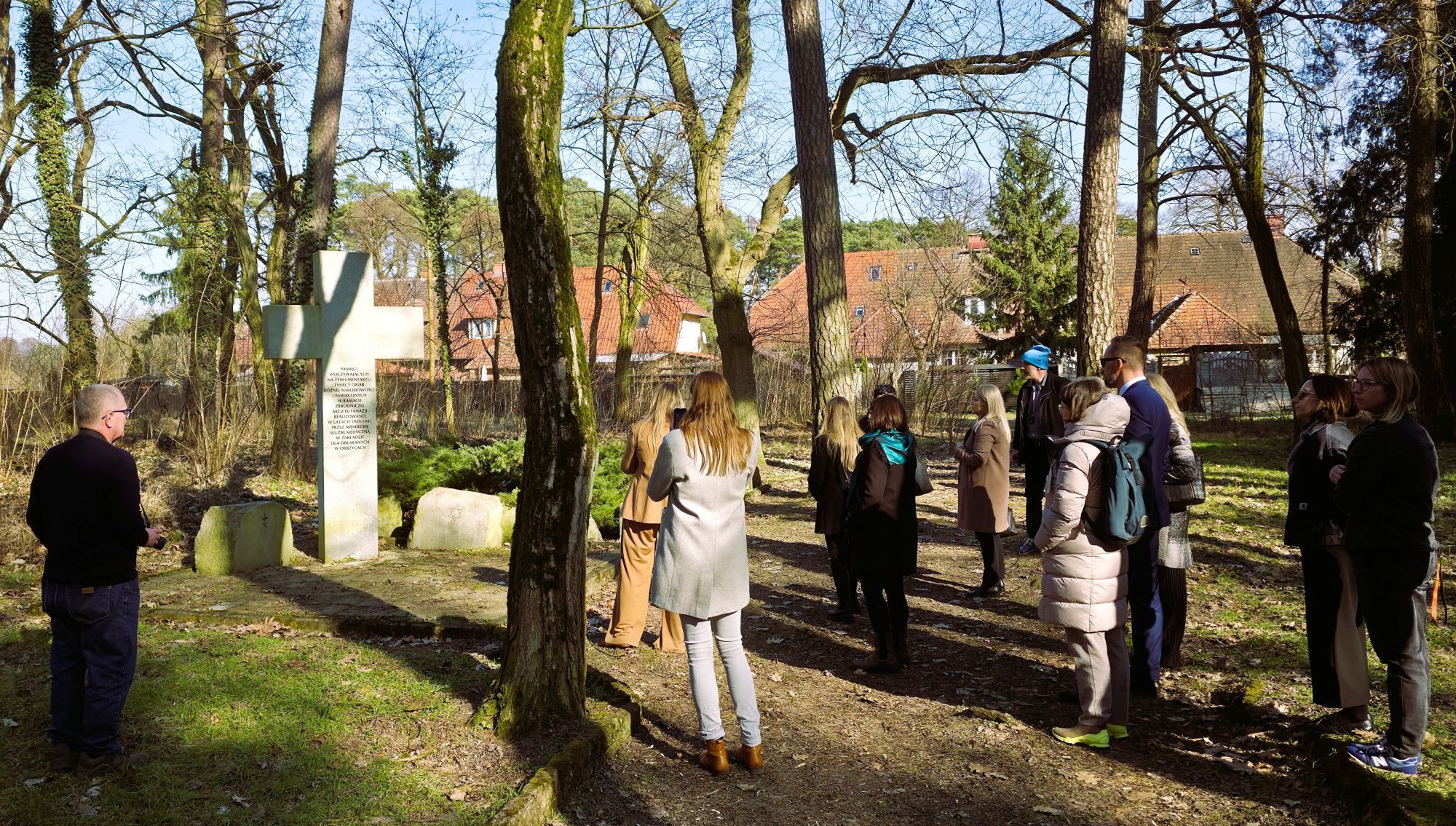
- Revitalisation of the Międzyrzecz-Obrzyce cemetery and memorial,
- Design and construction of a contemplation garden on the Międzyrzecz clinic grounds
Obrzyce as part of a German-Polish youth project with trainees from gardening and landscaping companies in Berlin and Międzyrzecz,
Development of an exhibition on the history of Nazi hospital murders in Ueckermünde in the AMEOS Clinic, - Development and linking of new and existing digital exhibitions on the history of the Nazi murders in Międzyrzecz-Obrzyce and Ueckermünde, Polish translation and linking of the „Totgeschwiegen“ exhibition in Berlin,
- Development of target group-orientated modules for educational tourism on the history of the Nazi murders of the sick at the project partners, networked in terms of content and for cross-border marketing.
„Traces of Jewish life“
- Cross-border measures for knowledge exchange and networking,
- Construction of a new memorial and meeting place „former Jewish cemetery Seelow“ at the former original site,
- Development of four circular routes with digital elements on traces of Jewish life in Seelow, Międzyrzecz, Ueckermünde and Berlin-Charlottenburg,
- Development of target group-orientated modules for educational tourism on traces of Jewish life at the project partners, networked in terms of content and for cross-border marketing.
In this way, the project meets the common challenge of improving mutual access to cultural heritage and to the tourist and cultural offerings in the assisted area and utilising the opportunities offered by culture and tourism to expand cross-border links.
The „Remembrance connects“ network provides a suitable framework for networking and disseminating the project's new educational tourism programmes. The project takes up the strategy of the multi-perspective remembrance landscape Oder-Warthe and consolidates the cross-border educational tourism offer for the significant era of the Second World War in the region.
Historical context
The cross-border approach and the need to involve partners outside the funding area arise from the distribution and role of the Nazi perpetrator sites in the former Reich territory. People with mental disabilities were isolated in the former clinic in Berlin, selected and deported to the sanatorium in Meseritz-Obrawalde, where around 10,000 people were murdered. A crematorium for the extermination of Nazi victims was set up and trialled for the first time on a hospital site at the Ueckermünde State Sanatorium. In line with the small number and distribution of today's memorials to the complex of Nazi hospital murders, there is a need to utilise previously untapped potential for remembrance work (Międzyrzecz, Ueckermünde) and to make it possible to experience history in context.
Preserving the traces of Jewish life is also an important task of German political remembrance work. Jews were repeatedly subjected to persecution and expulsion, most recently during the Nazi era, when the National Socialists systematically expelled and exterminated the entire Jewish population.
The forced migration of the population in connection with the westward shift of Poland as well as politically and ideologically driven cultures of remembrance in the former GDR and the People's Republic of Poland led to the neglect of many Jewish sites such as cemeteries and synagogues. There is a need to preserve traces and make history tangible across borders. The existing knowledge and experience of the project partners as well as locations and networks outside of the funded area are utilised and linked in order to achieve positive effects in the funded area.
Project partners
- Municipality of Międzyrzecz (Lead Partner)
- Marshal's Office of the Lubuskie Voivodeship, Department of Geodesy, Real Estate Management and Spatial Planning - Subdepartment of Spatial Planning
- Charlottenburg-Wilmersdorf district of Berlin
- City of Seelow (Mark)
- Town of Seebad Ueckermünde
- Rostock University Medical Centre
- Brandenburg Memorials Foundation, Memorial to the Victims of the Euthanasia Murders (associated partner)
Project duration: 01.01.2026 - 31.12.2028
Next activities
- September/October 2026, Berlin: Trainee Project Week 1 with workshops „Nazi Medical Murders“ and „Inclusion“
- October 2026, Brandenburg: Expert workshop „Educational Tourism with People with Disabilities“
- Nov. 2026, Seelow: Workshop „Traces of Jewish Life“
Project News

Kick-off conference for the „Living Places of Remembrance“ project“
The kick-off conference for the German-Polish project „Living Places of Remembrance“ brought together representatives of the project partners at Międzyrzecz Public Library.


Leave a Reply